Free trial →
Pranayama & shatkarma

The breath is the bridge.

Anyone who wants to practise pranayama should begin with Anulom Vilom, then Nadi Shodhana. Nadi Shodhana, the purification of the energy channels (nadis), is the basis of every other pranayama: the better it is practised, the better all the others will be. It brings the mind calm and alert, steadies body and mind, and deepens concentration, meditation and samadhi.

Hatha Yoga Pradipika 2.2
When prana moves, the mind moves. When prana is still, the mind is still. By this the yogi attains steadiness: so he should restrain the breath.
Bhagavad Gita 4.29: “Others offer the outgoing breath into the incoming and the incoming into the outgoing; restraining both, they are devoted to the control of the breath.”
Hatha Yoga Pradipika 2.44

The eight kumbhakas.

The Hatha Yoga Pradipika (2.44) names eight kumbhakas: Learn retention (kumbhaka), bandhas and the stronger techniques with a teacher, progressively. Never force the breath.

Surya BhedanaSurya Bhedana

Draw the air in slowly through the right nostril, hold it as long as comfortable, then breathe out slowly through the left (HYP 2.49).

UjjayiUjjayi

Mouth closed, inhale slowly through both nostrils with a soft sound, feeling the breath from the throat to the heart.

SitkariSitkari

Inhale through the mouth with a hissing sound, hold, and exhale only through the nose.

ShitaliShitali

Roll the tongue, inhale through it, hold, then exhale slowly through both nostrils.

BhastrikaBhastrika

Mouth closed, breathe out through the nose with a slight sound, then breathe in with force, again and again, feeling the breath in the heart, throat and head.

BhramariBhramari

Inhale, then exhale slowly with a deep humming sound, like a bee.

MurchhaMurchha

After a slow inhalation, apply Jalandhara bandha firmly and exhale very slowly.

PlaviniPlavini

Inhale slowly and fill the abdomen with air, hold without any bandha as long as comfortable, then exhale slowly.
Practice rules

How the texts say to practise.

Padadhirasana, the "breath-balancing pose", is practised before pranayama and meditation to balance the flow of breath in the two nostrils. It is also a bhavana practice, a contemplative awareness.

Hatha Yoga Pradipika 2.11Hatha Yoga Pradipika 2.11

Practise retention four times a day (early morning, midday, evening and midnight), increasing gradually up to eighty rounds in one sitting.

Hatha Yoga Pradipika 2.12Hatha Yoga Pradipika 2.12

At first there is perspiration, in the middle stage trembling, and in the highest stage complete steadiness.

Hatha Yoga Pradipika 2.14Hatha Yoga Pradipika 2.14

At the beginning a diet with milk and ghee is recommended; once the practice is established, such restrictions are no longer necessary.

Hatha Yoga Pradipika 2.16-17Hatha Yoga Pradipika 2.16-17

The text insists that pranayama must be practised correctly and progressively: improper practice disturbs the breath and can do harm.

Shatkarma

The six cleansing practices.

The Gheranda Samhita describes the path: the body is purified by the shatkarmas, made firm by asana, steady by mudra, patient by pratyahara, light by pranayama; the Self is seen in meditation, and freedom comes in samadhi. The Hatha Yoga Pradipika adds that the shatkarmas are first for those who need them; others may not. The shatkarmas are powerful cleansing techniques. Learn them only in person, from a qualified teacher. This guide describes them; it does not teach them for self-practice.

Cleansing of the digestive tractDhauti

Antar dhauti (vatsara, varisara, agnisara, bahishkrita), danta dhauti, hrid dhauti (vamana, vastra, danda), moola shodhana. The Gheranda Samhita counts 21 forms in all.

Cleansing of the lower bowelBasti

Jala basti and sthala basti (pavana basti).

Cleansing of the nasal passagesNeti

Jala neti and sutra neti (the thread is about 9 inches).

Abdominal churningNauli

Isolation and rolling of the abdominal muscles.

Steady gazingTrataka

Fixing the gaze on one point.

Skull-shining breathKapalabhati

Vatakrama, vyutkrama and shitkrama.

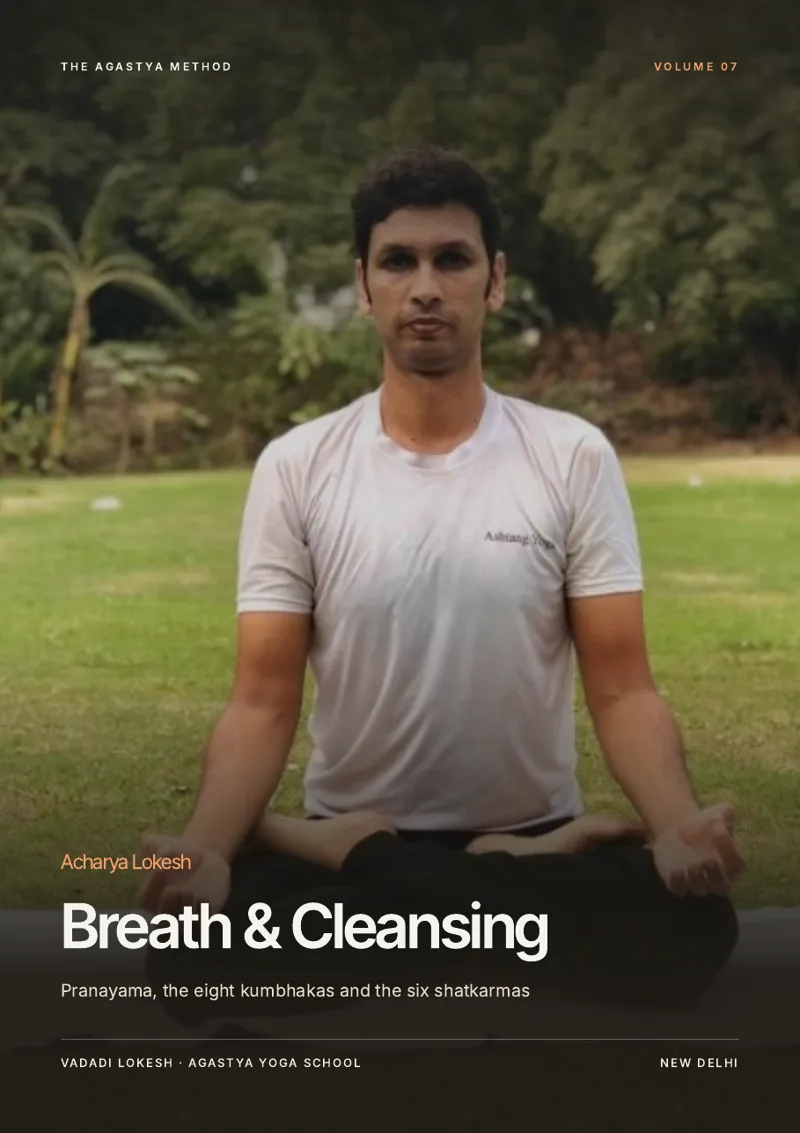
Breath & Cleansing, PDF guide cover
The Agastya Method · PDF · 9 pages

Breath & Cleansing

For practitioners who want to understand pranayama and the classical cleansing practices from the source texts.

  • Pranayama: Nadi Shodhana, the eight kumbhakas and the classical rules
  • The six shatkarmas (cleansing practices) and their sub-practices
  • Written for the YCB Level 2 (intermediate) syllabus, in clear English
$19
+ Cart

Instant download · secure payment by Stripe

WhatsApp